


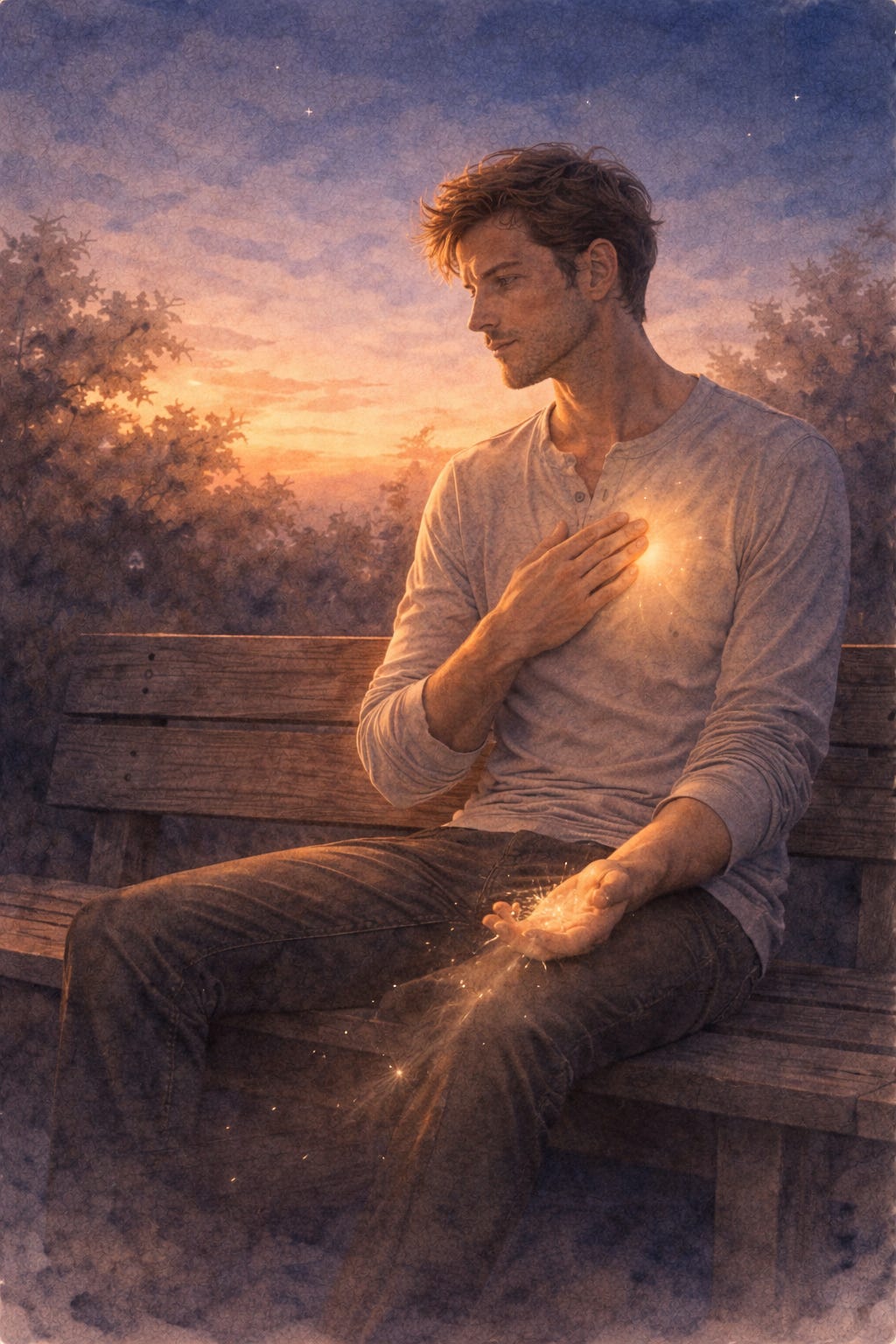
A man learns to laugh at the small things.
Someone cuts him off in traffic, and instead of clenching his jaw, he smiles and says to himself, “Maybe he really needs to go to the toilet.”
A meeting does not go his way, and instead of spiraling, he shrugs and whispers, “Perhaps this was not meant for me.”
A plan falls apart, and he exhales and says, “Something better must be waiting.”
It works. It works beautifully.
The humor becomes a shield. The lightness becomes a practice. He begins to notice that most of the things he used to grip so tightly were never worth the bruises on his palms.
He starts to believe he has mastered the art of letting go.
And then one night, the silence comes.
Not the peaceful kind. The kind that sits heavy on the chest.
The kind that reminds him of a voice, a laugh, a way someone once looked at him that made him feel like the world made sense.
And in that silence, the humor does not work. He cannot say “maybe it was not meant for me” because every part of him still whispers, “But it was. It was.”
This is the place where letting go stops being a technique and starts being a reckoning.
The truth is, not everything in life carries the same weight.
A rude driver touches the surface. A failed plan scratches the mind.
But a bond, a real one, does not live in the mind alone. It lives in the body. It wraps itself around the ribs. It settles into the breath. It hides in the quiet spaces between thoughts, waiting for a still moment to surface.
This is why a man can laugh at the world and still ache in the dark.
Because the world only touches his opinions. But a bond touches his identity. It touches the place where he once said, “I am yours,” and meant it with everything he had.
Letting go of an opinion is easy. Letting go of a part of yourself is something else entirely.
There is a teaching in Buddhist wisdom that speaks of two kinds of holding.
The first is the grip of preference. We want things to go a certain way, and when they do not, we suffer. This grip loosens quickly with awareness. A breath, a pause, a gentle reframe, and the hand opens.
The second is the grip of attachment.
This is not about preference. This is about love. About belonging. About the place we built inside another person and the home they built inside us.
This grip does not loosen with a joke or a shrug. It loosens the way a river shapes a stone. Slowly. Gently. Over time.
Not because the stone wants to change, but because the water never stops showing up.
And here is what the man begins to understand.
He does not need to force this. He does not need to pretend he is over it.
He does not need to rush toward some imagined finish line of healing where the ache disappears completely and he feels nothing.
He just needs to keep showing up.
Keep breathing. Keep sitting with it. Keep noticing when the grip tightens and choosing not to tighten with it.
Keep letting the river of his own patience do what force never could.
Because one morning, without announcement, he notices something.
The weight on his chest is a little lighter. Not gone. But lighter.
The silence does not scare him the way it used to. The memories still come, but they arrive more like old friends than open wounds.
And he realizes the grip is loosening. Not because he pulled it away. But because he finally stopped fighting it.
There is an ancient teaching that says wisdom is simply this: fixing your attention on the intelligence that guides all things.
Not your emotions. Not your impulses. Not the ache that rises unbidden in the silence.
But the quiet knowing underneath all of it that says, “Think before you act. Let your mind lead, not your wounds.”
This does not mean ignoring the feelings. It means not letting the feelings drive the car.
The man who laughs at traffic has already learned this for the small things. The next step is learning it for the things that shake his bones.
And here is a truth that most people discover too late.
The fear of letting go is almost always worse than the letting go itself. Fear is a creation of the mind. Most of what we dread never even arrives.
We build entire monuments to pain that has not yet happened and may never happen.
We grip tighter because we are afraid of what the open hand will feel like. But the open hand does not feel like emptiness. It feels like air. It feels like possibility.
It feels like the first breath after being underwater for too long.
You can love someone and still let go.
You can honor what was and still walk forward.
You can feel the ache and still choose yourself.
These are not contradictions. They are the quiet mathematics of a heart that is learning to hold space for everything at once.
So the man keeps going.
He still laughs at the bad drivers. He still shrugs at the broken plans. He still whispers “not meant for me” when life says no.
But when the silence comes, he does not run. He does not joke. He does not pretend.
He sits with it. He breathes through it. He places a hand on his own chest and says, “I know. I know. We are in this together.”
And slowly, so slowly that only the body can measure it, the grip becomes a gentle hold.
And the gentle hold becomes an open hand.
And the open hand becomes something he never expected.
Freedom.
From the journey of turning scars into stars.
Reflection for you, reader:
What are the things in your life you can already let go of with ease? And what is the one thing your body still holds, even when your mind says it is time?
What would it look like to stop forcing the release and instead trust the slow, patient loosening?
Where in your body do you feel the grip right now?
“You do not have to fight the river. You just have to stop holding on to the bank. The current already knows where to take you.”
A song that lives in the space between what was and what must be. Let it play when the silence comes. Not to make you sad, but to remind you that what you felt was real. And real things deserve to be honored, not erased.