


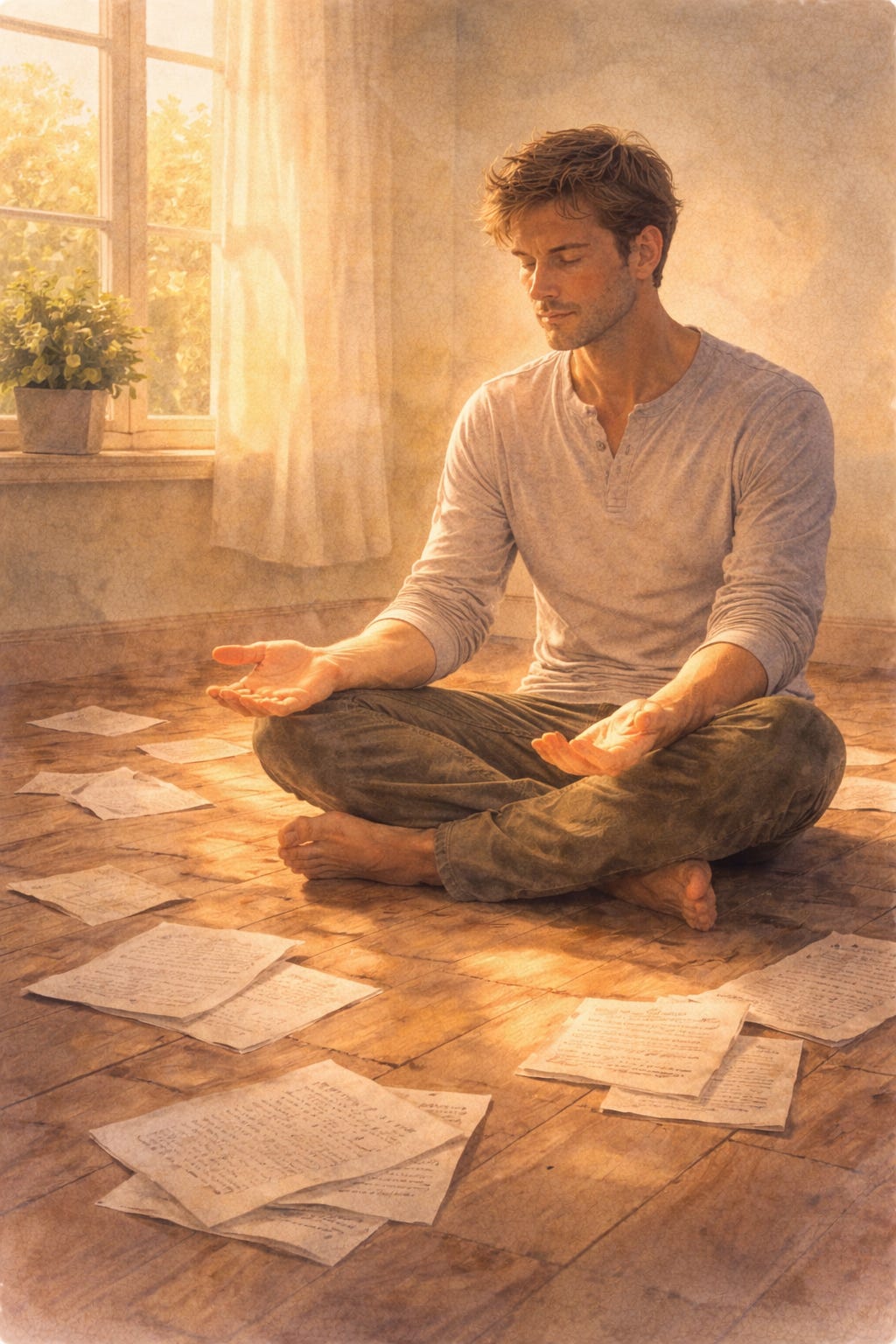
There is a voice inside every person that whispers the same lie.
You are not enough. Not yet. Not like this. Try harder. Do more. Be better. Then, maybe then, you will deserve to rest.
A man had been listening to that voice for years. It sounded like discipline. It sounded like ambition. It sounded, at times, like love. But it was none of those things. It was fear wearing the mask of motivation.
And for a long time, he obeyed.
The Critic Who Never Sleeps
The voice had rules. Do not make mistakes. Do not show weakness. Do not let anyone see the cracks. If someone leaves, it is because you were not enough. If something fails, it is because you did not try hard enough. If the world feels heavy, it is because you are carrying it wrong.
The voice never rested. It followed him into meditation. It followed him into silence. Even when the room was still and the breath was steady, the voice would find something to judge.
You should be further along by now. Others have figured this out. Why is it taking you so long?
A person can spend their entire life running from that voice without realizing they are also running from themselves. Because the critic is not a stranger. It is a frightened part of us that learned, somewhere along the way, that love was conditional. That acceptance had to be earned. That the only way to stay safe was to stay perfect.
But perfection was never the door to peace. It was the lock.
The Myth of the Flawless Life
Here is what the voice never tells you.
Perfection is not difficult. It is impossible. Not because you are weak. Not because you are broken. But because nothing in this world exists in isolation.
Every choice a person makes lands in a web of other people, other forces, other lives. You can study for months and still face a question you did not expect. You can love someone with everything you have and still watch them walk away. You can meditate every morning and still feel the pull of anxiety by afternoon.
This is not failure. This is the texture of being alive in a world that is deeply, irreversibly connected.
The ancient ones understood this. They called it interdependence. Nothing arises alone. Every moment is shaped by a thousand unseen hands. The river does not choose its course. It moves with the land, the rain, the season. And yet it still arrives at the sea.
A man can plan his entire life and still be surprised by Tuesday. That is not a flaw in the plan. That is the nature of living among others, of being woven into the fabric of something larger than any single thread.
The only way to achieve total control is to leave everything behind. Climb a mountain. Become a monk. Sever every tie. But that is not courage. That is escape.
The real practice is staying in the mess. Staying connected. Staying open. And letting go of the demand that it all be clean.
The Space Between Perfection and Giving Up
There is a word that sits quietly between perfectionism and mediocrity. Excellence.
Not the kind of excellence that demands flawless results. But the kind that asks only this: did you show up? Did you try? Did you learn something from the fall?
A person who strives for excellence does not collapse when things go wrong. They do not rewrite the story to make themselves the villain. They look at the B on the exam and say, that is a step, not a verdict. They look at the messy room and say, I will start with one corner. They look at the hard conversation and say, I did not handle it perfectly, but I was there.
Progress, not perfection.
The inner critic hates this. The critic wants absolutes. The critic wants all or nothing. And when it does not get perfection, it offers shame instead. As if shame ever built anything worth standing on.
But when a person learns to trade perfection for progress, something shifts. The weight lifts. The breath deepens. The mind, that restless child, stops thrashing and begins to settle. Not because it has been controlled. But because it has been met with kindness instead of judgment.
Holding Without Gripping
And then there is the hardest practice of all. Nonattachment.
Not numbness. Not apathy. Not building walls so high that nothing can reach you. Nonattachment is something quieter and braver than all of that. It is the willingness to hold everything, love, loss, hope, fear, and know that none of it is permanent.
A man learns this not from a book but from his own hands. He notices that the feelings still come. The longing still visits. The old stories still whisper. But they land differently now. Lighter. Like rain on a roof instead of rain through a broken ceiling.
He is not finished. He knows that. The practice of letting go is not a single act of release but a thousand small surrenders, repeated daily. Some days the grip loosens easily. Other days the fingers tighten before he even notices.
But he notices now. That is the difference. He notices the thought before it becomes a spiral. He feels the emotion before it becomes an identity. He catches the words “I am broken” and gently, without force, adds the quiet truth: sometimes.
I am afraid, sometimes. I am lonely, sometimes. I am lost, sometimes.
And sometimes I am none of those things.
The self is not fixed. It is a river. It moves. It changes shape with every bend. And the person standing at the bank today is not the same person who stood there last year. To insist otherwise is to freeze the water and call it freedom.
The Man Who Stopped Chasing
A man sits in his room. It is quiet. Not the quiet of avoidance, but the quiet of someone who has stopped running.
He is not perfect. His thoughts still wander. His heart still aches in the places where old wounds live. His phone is nearby but he does not reach for it, not because he has mastered discipline, but because for the first time in a long while, there is nothing he needs from the outside to fill what is inside.
He is reducing. Not his life, but his needs. Peeling back the layers of what he thought he required to be whole. And beneath those layers, something surprising. Himself. Unpolished. Imperfect. Still learning.
And that is enough.
Not because the journey is over. But because the destination was never perfection. It was presence. It was the willingness to sit with what is, without demanding that it be something else.
The Buddha smiled at impermanence. The Stoics found peace in what they could not control. Krishna told the warrior to act without attachment to the fruit of the action. Every tradition, in its own language, has been whispering the same thing.
Let go of the life you planned. And live the one that is waiting for you.
From the journey of turning scars into stars.
Sit with these:
Where in your life is the inner critic disguising fear as motivation? What would happen if you thanked it for trying to protect you, and then gently asked it to sit down?
What would your days look like if you replaced the question “am I doing this perfectly?” with “am I still showing up?”
What are you holding on to right now, not because it serves you, but because letting go feels like losing?
“Perfection is not the door to peace. It is the lock. Progress is the key. And presence is the room you have been looking for all along.”
A song about the blank page, the open road, the life that has not been written yet. Because when you stop trying to perfect the story, you finally get to live it.