


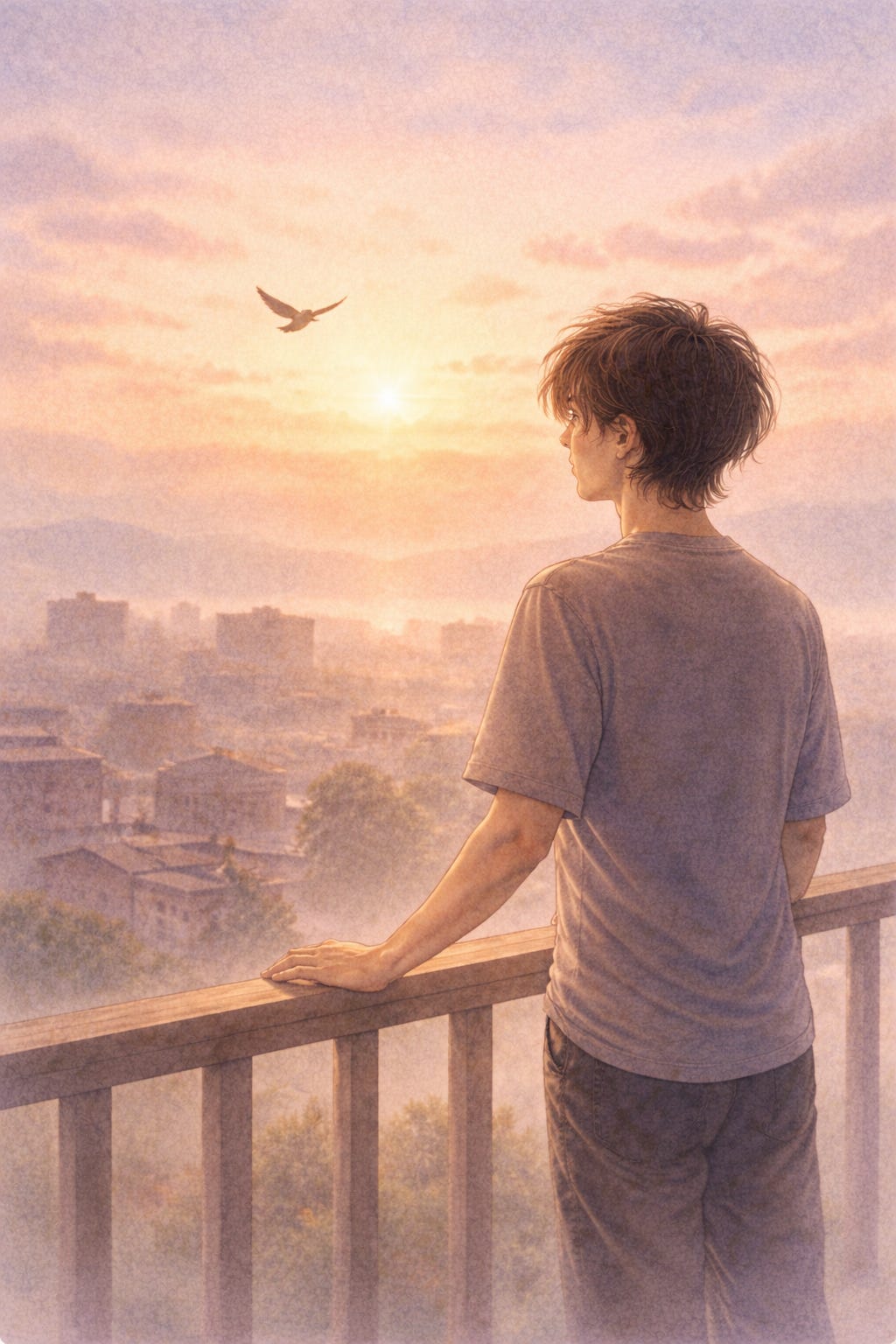
He notices that the fish swimming in his room are not separate from him. The pigeon that lands on his balcony is not a visitor but a neighbor, a companion sharing the same sky, the same air, the same fragile existence.
The plants on his windowsill are breathing with him. Everything near him has become an extension of himself, a widening circle of belonging.
This is not metaphor. This is what happens when a person practices compassion long enough. The boundaries begin to blur. The question “where do I end and the world begin” no longer has a clean answer.
And then death arrives, as it always does.
Three fish go still in the water. A pigeon falls silent on the balcony. The man feels it in his chest, a grief that surprises even him.
These were not just creatures living nearby. They were part of his world, part of his body in some way he cannot fully explain. Their passing is not happening “out there.” It is happening within.
The ancients understood this. The Stoics spoke of the universe as a single living organism, each of us a limb connected to the whole.
The Buddha taught that all beings share the same fundamental desire, to be free from suffering, to be at peace. When we see this clearly, the death of a sparrow becomes personal.
A Sikh master once gave two disciples a chicken and said, “Go where no one can see, and kill it.” One man went behind a shed and did it immediately. The other wandered for hours and returned with the chicken alive. “I cannot find such a place,” he said. “Everywhere I go, the chicken sees.”
To that man, the chicken was real. It was conscious. It felt.
Sometimes the universe does not whisper. It shouts.
In the same week the fish died, the man had a dream. He stood far from a tall building and watched a woman walk to the edge of the terrace and step off into the air. He woke unsettled, carrying something he could not name.
Then a friend at work suddenly gripped his chest and said, “Something is wrong.” They rushed to the hospital. The tests came back clear. Nothing serious. But the friend sat there shaken, and so did the man, because for a few hours they had both stood at the edge of something.
These arrivals in clusters are not coincidence. They are the universe tapping a person on the shoulder, saying: Look. Pay attention. Your time here is not guaranteed.
Here is what the man understood in the quiet that followed.
We must become strong first.
Not strong in the way the world defines it, not armored or defended, but rooted. Healed. Clear. Because we cannot pour from a vessel that is cracked and empty. We cannot stand beside others if we ourselves are falling.
The bodhisattva who vows to save all beings does not do so from a place of depletion. That aspiration arises from a fullness, from a heart that has first learned to hold itself.
This is the paradox the man had spent years misunderstanding. He had thought loving others meant abandoning himself. He had thought selflessness meant giving until there was nothing left. But true compassion begins at home. It widens outward only after it has taken root within.
There is another truth the man is sitting with now.
We do not want to leave this body carrying hurt.
Every grudge we hold, every wound we refuse to tend, every conversation we never had—these become weight. And when the time comes, whether it is in sixty years or sixty days, we will carry that weight with us to the edge.
The work, then, is not just healing for the sake of feeling better. It is healing so that we can go light. So that when we step forward into whatever comes next, we are not dragging the past behind us like chains.
The fish and the pigeon did not leave with unfinished business. They simply left. There is something to learn from that simplicity.
The man looks at his room now and sees it differently.
The remaining fish are still swimming. The balcony is empty but not abandoned. The world is still breathing with him, around him, through him. And he understands that widening the circle of compassion does not mean taking on the suffering of the world. It means recognizing that the world is already part of him, and he is already part of it.
The question is not whether to care. The question is whether to care from a place of fullness or a place of lack.
He is choosing fullness. One breath at a time.
a melody that moves like water, carrying both grief and peace.