


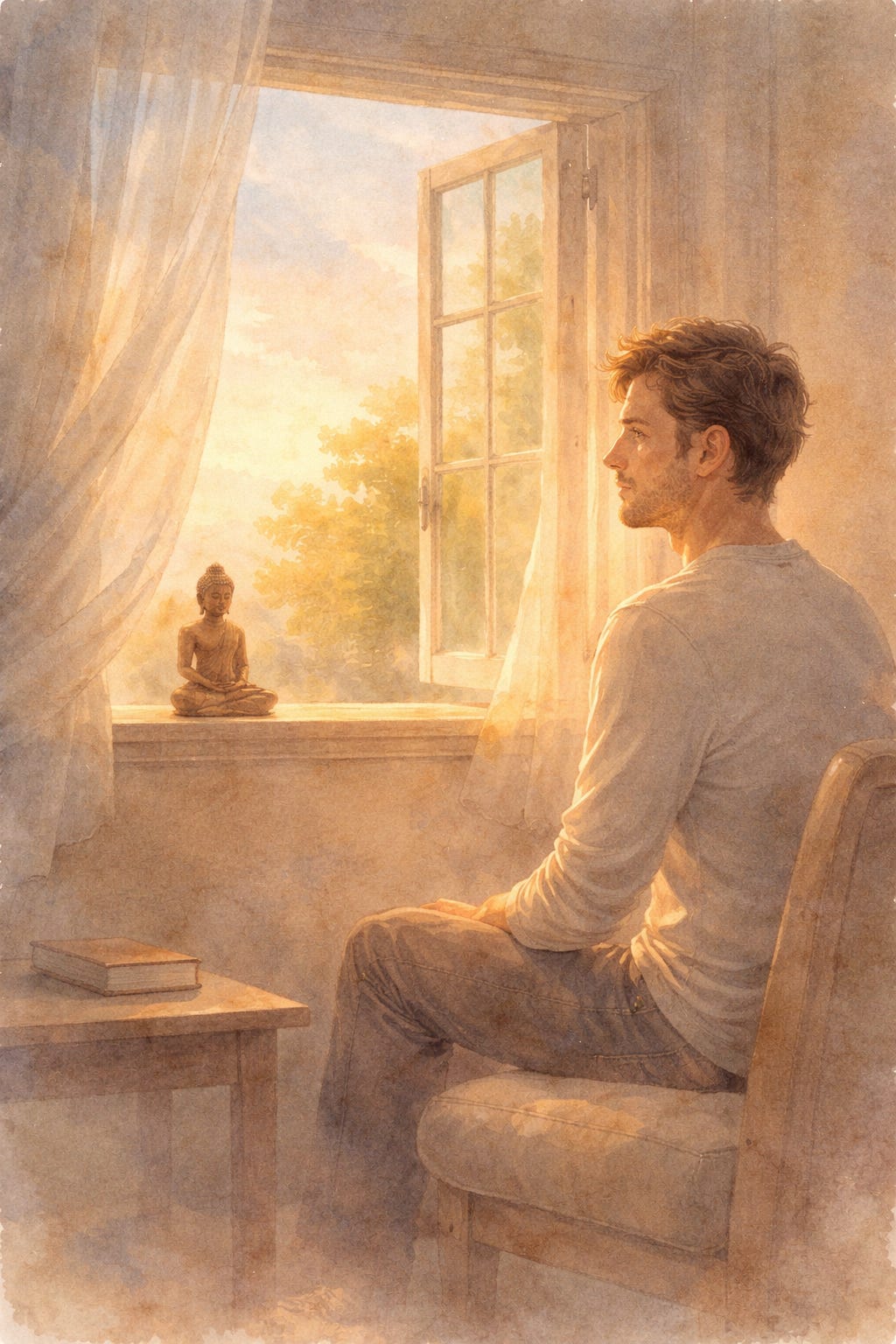
A man sits with a book in his hands.
The author is telling him that healing happens in connection. That we cannot awaken alone. That the walls we build to protect ourselves are the very walls that imprison us.
He reads the words slowly. He understands them. But something in his chest tightens, because he has heard this before. Not from a book. From life.
He has been open. He has let people in. He has handed his heart to someone and watched them hold it carelessly, not out of cruelty, but out of their own inability to hold anything gently. And he did it again. And again.
So when the book says be open, something inside him whispers back.
But what if I open and they misuse it?
It is not a cynical question. It is a bruise asking whether it is safe to be touched again.
The Window and the Glass
Think of a window.
A window lets light and air into a room. Without it, the room becomes stale, dark, suffocating. But a window without glass lets in the rain, the dust, the cold.
The window is not the problem. The missing glass is.
Boundaries are not walls. Walls block everything, the good and the bad, the light and the storm. Boundaries are glass. They let you see clearly. They let warmth in. But they also protect what is inside from what does not belong there.
A person can be warm and kind to everyone they meet. That costs very little and keeps the heart soft. But deep vulnerability, the sharing of wounds, fears, the unfinished and tender places, that is something different. That is opening the window itself. And not everyone has earned the right to climb through.
The Buddha radiated loving kindness to all beings. But even the Buddha chose his sangha carefully.
The Deeper Question
But then a deeper question arrives, as deeper questions always do when you sit with the first one long enough.
If every moment brings a different version of a person, if the one who loves you today may not love you tomorrow, if impermanence touches everything and everyone without exception, then what is the point of opening at all?
Why trust anyone when trust has an expiration date you cannot read?
This is where the heart wants to close. This is where the mind says, See? I told you. Safer alone.
And yet.
The Meditation and the Storm
Consider meditation.
A person sits down to meditate not because they expect every session to be peaceful. Some sessions are storms. Some are silence. Some are nothing at all. But they sit anyway.
Not because the outcome is guaranteed, but because the act of sitting, of showing up, of being present to whatever arrives, is the practice itself.
Relationships are no different.
We do not open to someone because they will always be safe. We open because in this moment, the connection is real. And if tomorrow brings a different version of that person, we grieve that version, we adjust, we let go.
But we do not punish today for tomorrow’s uncertainty.
Marcus Aurelius would hold his children and remind himself that they were mortal. Not to diminish the love, but to deepen it. To say, this moment is precious precisely because it will not last.
Krishna tells Arjuna on the battlefield, do your duty without clinging to the result. In relationships, this becomes something quieter but no less brave. Love without demanding permanence. Be present without requiring a guarantee.
That is not naive. That is perhaps the bravest thing a human being can do.
The Foundation That Does Not Break
But bravery without foundation is recklessness. And this is the piece that changes everything.
When a person is whole within themselves, when they have learned to fill the gaps they once tried to fill with other people, then someone changing or leaving does not destroy them.
It hurts. Grief is real and should be honored. But they do not collapse, because their foundation is not built on another person. It is built on themselves.
Self-love is not selfishness. Selfishness says, I matter, you do not. Self-love says, I matter too. And from that quiet, steady place of mattering, a person can meet each changing version of each person they encounter with presence rather than fear, with openness rather than desperation.
So perhaps the balance looks something like this.
Keep your heart soft. Let compassion flow outward without condition. But watch before you reveal. Observe how someone handles their own pain before you hand them yours. Notice whether their presence makes you more yourself or less.
The sacred pause, that gap between what happens and how you respond, applies not just to anger or fear but to trust itself.
And when impermanence does what impermanence always does, when someone you loved becomes someone you once knew, let the grief come. Sit with it the way you would sit with any wave in meditation. Feeling it fully, breathing through it, knowing it belongs to something larger than your story alone.
The window stays open. The glass stays in place. And the light keeps coming.
From the journey of turning scars into stars.
Reflection for you, reader
Have you ever closed yourself off completely to avoid being hurt, and realized the isolation hurt more than the wound you were avoiding?
When you think about the people closest to you, do you love them as they are right now, or are you loving a version of them you are afraid to lose?
What would it feel like to be fully open and fully whole at the same time, to need nothing from anyone, yet choose connection anyway?
Because sometimes we only understand the value of openness after we have shut every door.