


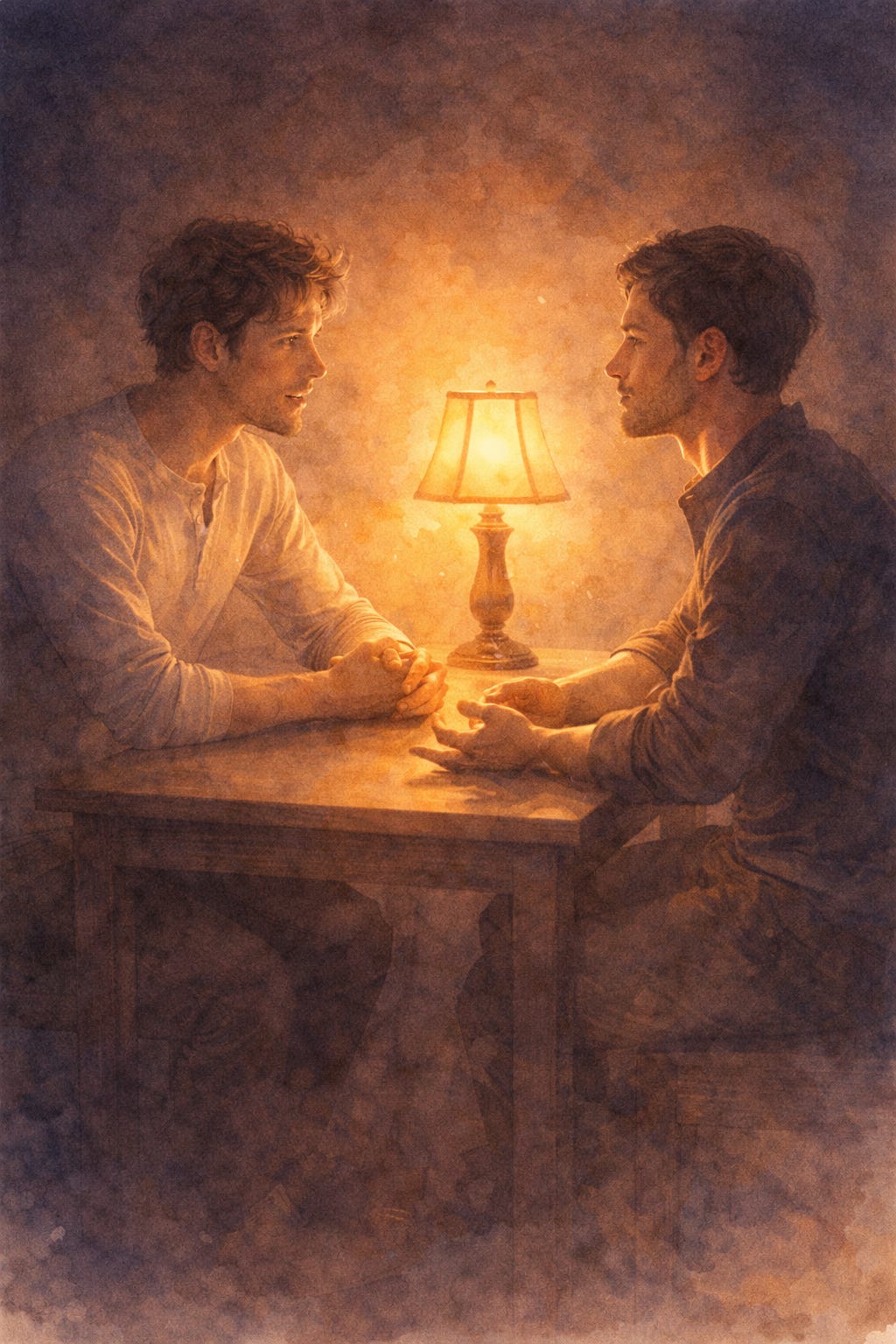
A man was sitting across from someone he barely knew.
It was one of those conversations that was not supposed to mean anything. Two people, brought together by circumstance, filling time with words. But then the stranger asked a question that most people never ask. Not because they do not care, but because they are afraid of the answer.
What is your plan for the future?
The man did not hesitate. He said, four or five more years of work, and then he would step away. He had enough. Not in the way the world defines enough, not the mansion, not the empire, not the legacy carved in marble. He meant something quieter. He meant that his needs had become small, and his peace had become large, and somewhere in between those two things, he had stopped chasing.
The stranger looked at him for a long moment. And then he said something the man did not expect.
That is too early for someone your age. What you are describing is self-realization. It is like standing at the edge of a cliff where nothing can make you too sad and nothing can make you too happy.
The man went quiet. Not because the stranger was wrong. But because the stranger had named something he had not yet named himself.
The Cliff
There is a place inside a person that is difficult to describe to anyone who has not been there.
It is not depression. It is not joy. It is not the numbness that comes from running away from pain. It is something else entirely. It is what remains when a person has stopped reaching for things that were never his to hold.
The ancient Stoics had a word for it. They spoke of the dichotomy of control, the understanding that some things live inside your hands and some things do not. Your effort, your character, your response to what life brings, these are yours. Another person’s choices, the timing of the world, whether the ones you love decide to stay, these were never yours. Not even for a moment.
A person can know this in his mind for years. He can read it in books. He can underline it and nod along and even teach it to others. But there comes a day when the knowing drops from the head into the chest, and on that day, something shifts. The grip loosens. The chase slows. And a strange silence settles in.
Not emptiness. Stillness.
But to someone watching from the outside, it can look like a man who has given up too soon.
The Accounts We Carry
The man had not always lived this way.
There was a time when he gave everything to everyone. His time, his energy, his heart, his trust. He was the person others called when they needed something, and he always answered. Not because he wanted something back. But because that was who he thought he was. The giver. The fixer. The one who shows up.
And some of them used him for it.
He knew. He was not blind. He could see when someone reached out not because they cared but because they needed something. He could feel the difference between a hand extended in friendship and a hand extended in hunger.
But here is where the man surprised himself.
He did not become bitter.
Instead, he did something that most people never learn to do. He looked at the person using him and thought, perhaps I used someone like this in another life. Perhaps this is the account being settled. Perhaps this is not injustice. Perhaps this is balance.
This is not weakness. This is not foolishness. This is a man who has decided that carrying resentment costs more than the thing he lost. It is a man who understood, deeply, that you cannot control what others take from you, but you can control what you carry afterward.
The Gita speaks of this quietly. Do what is right, and release the fruit. Not because the fruit does not matter. But because the clinging to it, the scorekeeping, the silent ledger of who owes what to whom, that is the real weight. That is the chain. And a man who wants to be free must set it down, even when the world says he has every right to hold on.
The Man Across the Table
But the stranger. The stranger was something else.
As the conversation continued, the man learned things he did not expect. This person sitting across from him, this person he barely knew, had quietly adopted an orphan. Not for recognition. Not for applause. He simply saw a child who needed someone, and he became that someone.
He ran his company not like a man trying to prove something, but like a man who had already proven it to himself and was now free to build something real.
There was an aura to him. Not the kind that announces itself. The kind that simply is. The kind you recognize not with your eyes but with something deeper, something the Buddha might call right seeing, the ability to perceive not what a person shows the world but what a person carries inside.
And the man sitting across from him thought, this is what it looks like.
Not the philosophy. Not the teachings. Not the underlined passages in the books. This is what it looks like when a person has drawn the small circle and filled it with everything that matters, his actions, his integrity, his quiet generosity, and stopped wasting a single breath on the rest.
The Question That Stayed
The conversation ended the way most unexpected conversations do. With a handshake, perhaps. A polite farewell. A return to separate lives.
But the question stayed.
Is it too early?
The man turned it over in his mind the way you turn a stone in your hand, feeling its edges, its weight.
And he realized that the question was not really about age. It was about something deeper. It was about whether a man has earned the right to stop wanting. Whether letting go of the chase is wisdom or retreat. Whether standing on the cliff of enough is the destination or just a rest stop.
The Stoics would say that the only thing too early is pretending you have arrived when you have not done the work. But if the work has been done, if the hands have opened honestly, if the accounts have been settled not with revenge but with grace, then there is no such thing as too early. There is only readiness.
And the Buddha would smile and say nothing at all. Because the man who asks whether he is ready already knows the answer.
Coming Home to Yourself
Here is what the man understood on the way home.
The people who use you, let them go. Not with anger. Not with a speech. With the quiet understanding that some debts are older than this life, and some accounts close themselves when you stop keeping score.
The people who see you, hold them close. Not with need. Not with grip. With the open hand of a person who has learned that real connection does not require chains.
And the stranger who shows up one evening and asks you a question you were not ready for, pay attention. Life does not always send its teachers in robes and silence. Sometimes it sends them across a table, in the middle of an ordinary night, wearing no label at all.
The dichotomy of control is not just a philosophy. It is a way of living. It is the daily practice of asking, is this mine to hold? And when the answer is no, setting it down. And when the answer is yes, holding it with everything you have.
Not because you will get something in return. But because that is who you chose to be.
And that, in the end, is the only circle that matters.
From the journey of turning scars into stars.
Reflect:
When was the last time a stranger said something that made you see yourself differently?
What accounts are you still keeping in your head, and what would it feel like to close them, not with justice, but with grace?
If nothing could make you too sad and nothing could make you too happy, would that feel like freedom or would it frighten you?
A raw, honest meditation on becoming someone you did not plan to be, and realizing that the person you are becoming is closer to the truth than the person you were trying to hold together.