


There is a moment that comes to everyone, though we do not speak of it often.
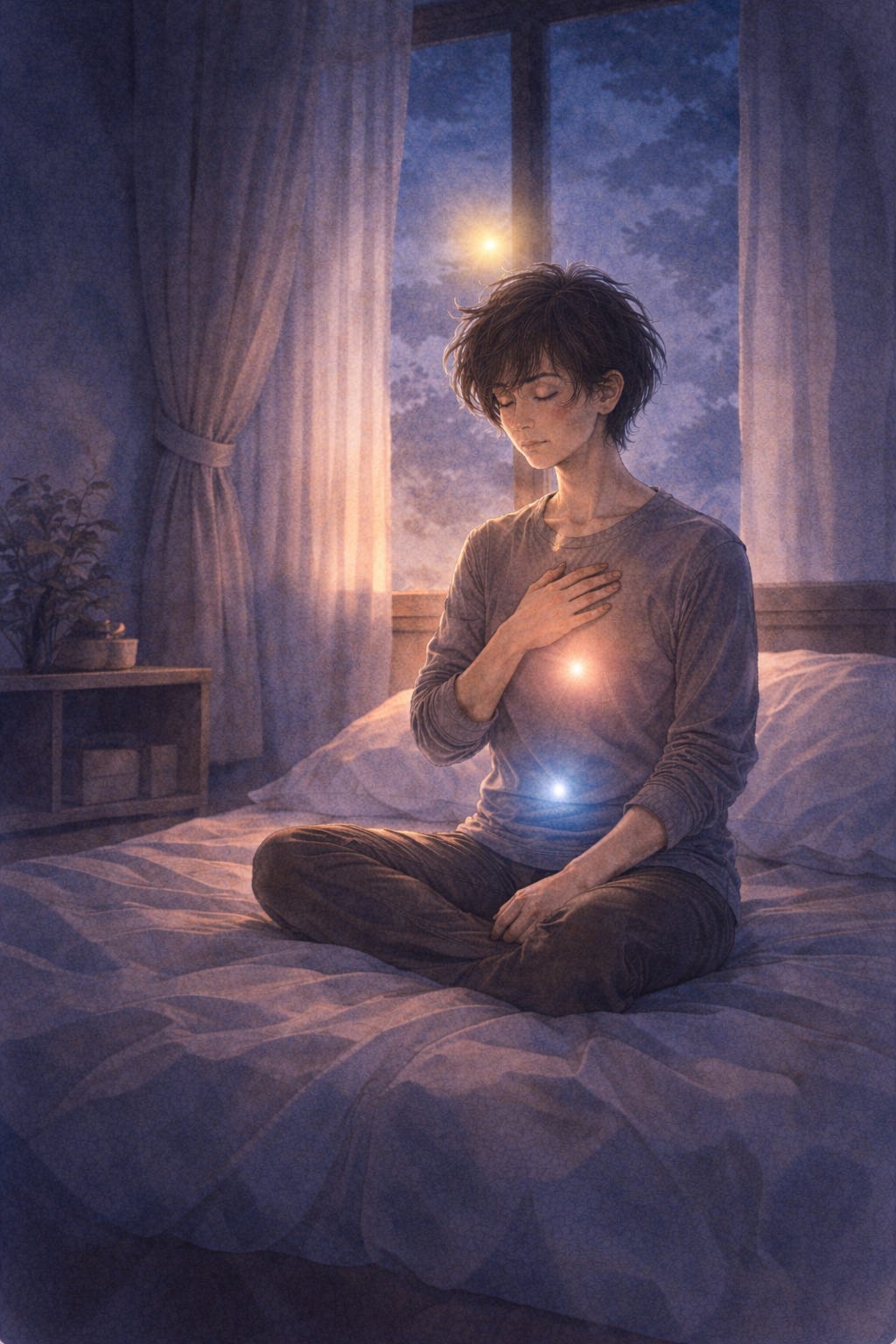
It is late. The house is quiet. A man lies awake, staring at the ceiling, turning the same thoughts over and over like stones in his palm. Something has ended. A relationship, perhaps. A chapter. A version of himself he thought would last forever.
He reaches for his phone. Scrolls through names. His mother would worry. His friend has troubles of her own. The teacher he admires lives on the other side of the world, surrounded by thousands. He would never know this man’s name.
He puts the phone down.
And in that silence, he feels it. The weight of a truth he has been avoiding.
No one is coming.
Not tonight. Not to fix this. Not to hold him while the ache moves through. Not to tell him what to do next.
He is alone.
For most of his life, he believed healing required someone else. A guru who would see him clearly. A partner who would love him completely. A friend who would always answer.
But here, in the dark, he faces something different.
He could keep waiting. He could scroll, distract, numb. He could let the mind spiral until exhaustion drags him under.
Or he could try something he had read about but never truly done.
He could become his own guide.
Slowly, he sits up. Places one hand on his chest. Feels the heart beating, fast and unsteady. Takes a breath. Then another.
And then he speaks. Not in his head, but softly, out loud, the way one might speak to a frightened child.
I know you are hurting. I am here. We will sit with this together.
The words feel strange at first. But something in his chest softens. The heart, clenched tight for weeks, releases just a little.
He keeps his hand there. Keeps breathing.
And for the first time in a long while, he does not leave himself.
The Buddha, on his final night, told his disciples: Be a lamp unto yourself. Be your own refuge.
Not because others cannot help. But because the deepest healing begins when we stop abandoning ourselves.
In the days that followed, the man noticed something.
Being present was heavier than escaping into the future.
The future is light. It floats. The mind drifts there easily, planning, imagining, rehearsing conversations that may never happen. It feels like progress. But it is actually abandonment. You leave the present moment unattended, unheld.
When you choose to stay, fully stay, you feel the weight of it. The body becomes real. The emotions become vivid. There is nowhere to hide.
This heaviness is not punishment. It is the weight of reality. And reality, once accepted, becomes the only solid ground.
He noticed it while reading one evening. The mind wandered. To tomorrow. To yesterday. To what was lost.
He used to scold himself for this. Call himself weak, distracted, broken.
Now he simply said, We are reading. Let us read together.
And slowly, gently, the mind returned.
No war. No force. Just an invitation to come back.
The Zen masters call this beginner’s mind. The willingness to return, again and again, without judgment. The practice is not in staying perfectly still. The practice is in the returning.
There is a trio that lives within us. Mind, body, heart.
They are not enemies. They are not separate forces fighting for control. They are companions. Best friends, if we let them be.
When the mind spirals, the heart can offer tenderness.
When the heart grows heavy, the body can ground us in breath.
When the body aches, the mind can whisper, Rest. You have carried enough.
Krishna speaks of this in the Gita. The one who brings mind, body, and spirit into harmony finds peace even in the midst of action. The battlefield is within. And victory is not conquest. It is alignment.
To become your own spiritual guide is to help these three stand for each other. To listen to each one. To become both the holder and the held.
Months passed.
The man still read books by the teachers he admired. Still listened to talks, sought wisdom wherever he could find it.
But something had changed.
He no longer looked to them for answers. He looked to them for mirrors. Their words helped him see his own truth more clearly. But the real guidance happened inside.
When the book closes, when the silence returns, he trusts now that he has what he needs. The answers are not hidden in some distant monastery. They are waiting within, patient and quiet, ready to be found by the only guide who can reach them.
Himself.
Lord Ram walked fourteen years in exile. Not running, not resisting. Simply walking. Each step was the path. Each day was the practice.
This man is learning the same. That the path is not easy. But it is not difficult either.
That alignment does not come in a single moment. It comes slowly, slowly, one breath at a time.
That the heaviness he feels when he chooses presence over escape is not failure.
It is the feeling of finally being here.
From the journey of turning scars into stars.
Reflection for you, reader:
What question have you been afraid to ask yourself?
What would it mean to sit with that question, not to answer it, but simply to hold it?
When did you last let mind, body, and heart speak to each other, without rushing to fix anything?
A song about light returning after a long, cold winter. About the moment when you realize the darkness was never permanent. You held yourself through the night, and now, slowly, slowly, the sun is coming.