


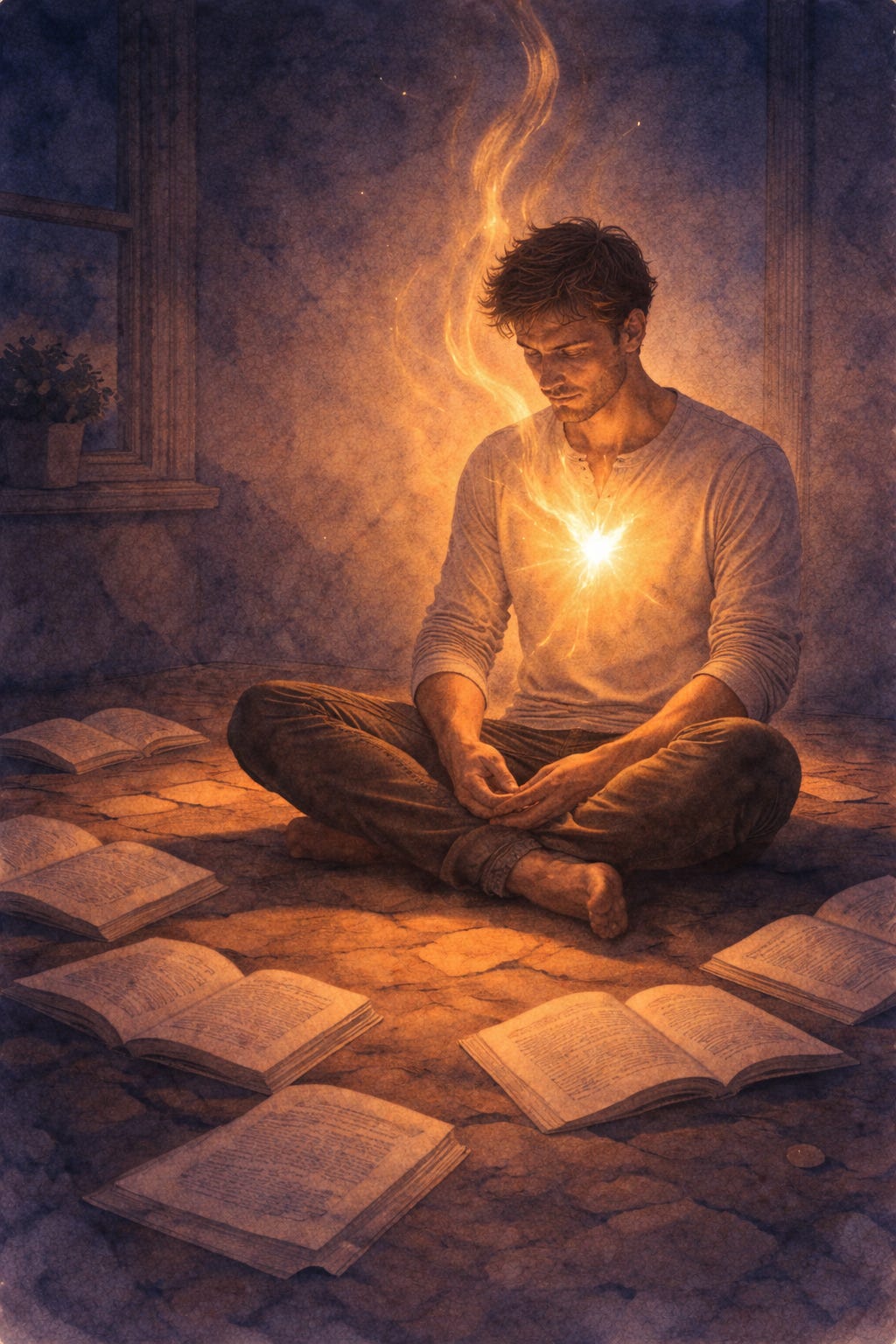
A man reads a book about letting go.
The book tells him to imagine his future self. To picture the consequences. To visualize who he will become if he does not change.
He nods. He highlights the passage. He even tells a friend about it.
And then he does nothing.
There is a cigarette pack in almost every country in the world that carries a picture of what smoking does to the lungs.
Black tissue. Crumbling organs. A warning printed in bold letters.
The smoker sees it every single day.
He holds the consequence in his hand, lights a match, and inhales anyway.
This is the great lie of self-help. That knowing the future will change the present.
It will not.
A person can see exactly where the road leads and still walk down it. Not because they are foolish, but because knowledge without fire is just information.
And information has never moved a single human being from where they are stuck.
What moves a person is will.
Not the kind that comes from imagining disaster. Not the kind borrowed from fear.
But the kind that catches fire somewhere deep inside the chest. The kind that wakes up one morning and says, simply, enough.
The Soldier and the Dreamer
Marcus Aurelius wrote about how the things that upset us are often like bad dreams. Vivid and convincing while we are inside them, but absurd once we wake.
He was not talking about pretending life is easy.
He was saying something far more radical.
That most of the suffering we carry is not happening right now. It is a projection. A rehearsal.
A nightmare we are choosing to stay inside even after our eyes have opened.
The smoker who imagines cancer in twenty years is dreaming a bad dream. But the dream does not make him stop. It only adds fear to his habit.
What makes him stop is the morning he wakes up, looks at his child, and something shifts. Not in his head. In his chest. In his bones.
That is not visualization. That is will arriving uninvited, the way grace always does.
What Stays and What Passes
There is an old wisdom, passed quietly from one generation to the next.
Even the time you love does not stay. So how will the time you hate stay either?
Have patience. It will pass.
This is not about pretending pain does not matter. It is about understanding that pain, like joy, is a visitor. It arrives without asking. It leaves without warning.
The person who knows this does not waste energy fighting the arrival. They do not cling to the departure.
They sit with whatever is here and trust that it is moving, always moving, even when it feels permanent.
Robin Sharma reminds us that all human progress has come from those who had the courage to ignore the crowd and follow what felt right, even when it brought uncertainty and fear.
The crowd says imagine your future. Scare yourself into change.
But the ones who actually change? They do not scare themselves forward. They burn their way through.
And they trust that whatever season they are in will not last forever.
The Room You Cannot Leave
Another popular teaching says that when emotions run high, leave the room. Step away. Remove yourself from the situation.
It sounds wise. It sounds like a pause.
But there is a difference between taking a breath and running from a fire.
A man can leave the room. He can walk to the balcony, drive to the park, fly to another city.
And the moment he sits down, the mind is right there beside him. Unpacking the same suitcase of thoughts it carried from the room he just left.
The mind does not respect geography. It does not care about distance. It follows you everywhere because it lives inside you.
The Buddha understood this. He sat beneath one tree and refused to move.
Everything came to him there. Every fear, every temptation, every voice that told him to get up and run.
He did not move. He sat with it until it passed through him.
That is the difference between escape and stillness.
Taking a pause is sacred. Breathing fresh air when the chest feels tight is wisdom.
But these things can be done without abandoning your ground.
The pause is not a place. It is a space between what happens to you and how you respond. And that space exists wherever you are standing.
When the Storm Arrives
So if techniques do not save us and running does not work, what does a person do when conflict finds them?
There is a way through. And it does not require leaving yourself behind.
It begins with seeing the other person clearly. Not to excuse them. Not to absorb their pain. But to understand why they are doing what they are doing.
No one acts without a reason. Seeing the reason does not make you smaller. It makes you more intelligent. It is the difference between reacting blind and responding with full sight.
Then comes the hardest part. The moment where the old pattern whispers, just apologize, just make it stop.
But not every fire is yours to put out. Sometimes the other person needs to sit in the discomfort of what they created.
A person who has spent years being the peacekeeper, the absorber, the one who says sorry first just to stop the tension, knows this trap well.
The apology is not about truth. It is about making the room quieter at their own expense.
So before the words leave the mouth, there is a question worth asking. Is this mine to carry, or am I just erasing myself again?
Own what is genuinely yours. Only yours.
Saying “it is my fault” to reach a solution faster sounds mature. But if the fault is not yours, you are not solving anything. You are disappearing.
A real solution sometimes sounds like this. This part is mine, and I will hold it. That part is yours. Let each person carry their own weight.
And then, when the dust settles, forgive yourself for being in the situation at all. For not seeing it coming. For caring too much or trusting too soon.
When you are ready, forgive the other person too. Not for their sake. For yours.
Because carrying someone else’s weight in your chest is a punishment you are giving yourself. And you have suffered enough.
Breathe. Step outside for two minutes if you need to. Let the fresh air remind your body that it is safe.
But come back. Do not confuse a reset with a retreat.
The Quiet Rebellion
There is a kind of courage that does not look like courage at all.
It looks like a person sitting still when everything inside them wants to run.
It looks like someone choosing not to apologize when the old pattern begs them to.
It looks like a man reading a book, disagreeing with the author, and trusting his own lived experience over a printed technique.
That is the fire.
Not the knowledge of what could go wrong. Not the fear of consequences. But the quiet, unshakable knowing that you have already been through enough to trust yourself.
The dream Marcus Aurelius spoke of is not just the nightmare of fear. It is also the dream that someone else’s framework will save you.
That the right book, the right step-by-step guide, the right visualization will do the work that only your own will can do.
Wake up from that dream too.
The fire is already lit. It has been lit since the first time you chose yourself over your old patterns.
Since the first time you said no when everything in you wanted to say yes.
You do not need a technique to fan it.
You just need to stop pretending it is not there.
From the journey of turning scars into stars.
Reflections for You, Reader
Where in your life are you confusing knowing with doing?
When conflict arrives, do you apologize to find peace, or do you pause to find truth first?
What would change if you trusted the fire inside you more than the framework in front of you?
What season are you in right now, and can you trust that it is already moving?
Because the fire is not born from comfort. It is born from everything that tried to break you.
The pain, the patterns, the years of absorbing everyone else’s weight. All of it became fuel. And now you burn, not with anger, but with belief in yourself.